

Hidden Connections, Hidden Risks: Uncovering Unknown Farm Taps in a Texas Pipeline Segment
Explore how PipeTest and PipeScan were deployed to help a major operator uncover previously unknown farm taps and dresser couplings during hydrostatic testing, ensuring the pipeline was brought safely back into service.
Project Background
In April 2025, PipeSense was contracted by a U.S.-based pipeline operator to monitor the hydrotest of a pipeline segment in Texas. The scope was straightforward: supplement the hydrotest contractor’s efforts with PipeSense’s PipeTest monitoring system, ensuring accurate leak location data was captured during the fill, stabilization, and test-hold phases.
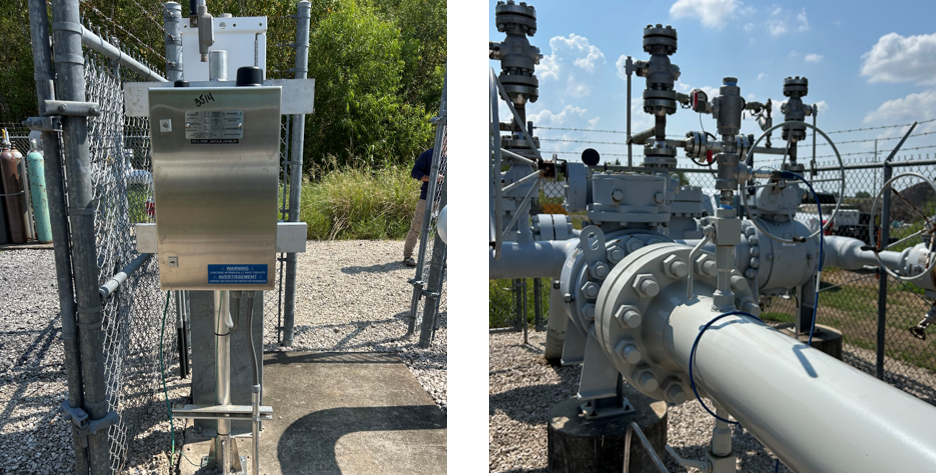
PipeSense deployed Field Processing Units (FPUs) at strategic points along the line, each outfitted with high-speed pressure sensors capable of capturing pipeline data at 1,000 samples per second. These FPUs, linked to PipeSense’s patented analytics, allowed real-time monitoring of bore pressure fluctuations and precise identification of anomalies.
Unlike traditional hydrotesting, which may confirm only whether a line holds pressure, PipeTest provides pinpoint leak location, reducing guesswork and excavation. The system can identify new leak events in seconds and locate pre-existing leaks during fill or dewater, often with an accuracy of less than 100 feet.
Commencing what was expected to be a routine integrity validation, our on-site engineers quickly discovered deeper issues: pressure loss and unexplained leakage, suggesting hidden infrastructure.
Deployment & Early Signs of Trouble
As the line was filled and stabilized, anomalies emerged. Pressure drops of approximately 10 psi per hour were recorded, beyond expected temperature-related fluctuations. The PipeTest system flagged multiple points of concern, correlating with potential leak signatures.
Operators initially suspected small weeps, but PipeSense’s data analysis pointed to something more: previously undocumented farm taps and dresser couplings acting as leak points.
Introduced as a convenience in the mid-20th century, farm taps are direct service lines connected to transmission pipelines, typically feeding individual homes or farms. Never designed to be permanent fixtures in a transmission environment, farm taps now present three categories of challenges today:
1 – Regulatory Ambiguity – Who owns the tap? Who maintains it? PHMSA has clarified expectations, but many older taps remain in limbo.
2 – Safety Risks – If improperly abandoned, a closed farm tap can still contain pressurized gas or weakened fittings that may leak under stress.
3 – Record Gaps – Many operators rely on outdated KMZ or GIS maps. In cases where taps were installed without formal documentation, records are incomplete or inaccurate.
When an operator believes their line is fully mapped and compliant, discovering hidden farm taps mid-project can derail schedules, add repair costs, and create regulatory exposure.
Locating the Hidden Taps
Using a combination of real-time monitoring and offline analysis, PipeSense identified multiple precise GPS coordinates where anomalies suggested hidden connections. Each of these points corresponded to farm taps or dresser couplings that had not been captured in the operator’s KMZ mapping files.
By locating these features, PipeSense provided actionable intelligence that enabled repairs before the final test-hold was conducted.
Repair, Retest, and Results
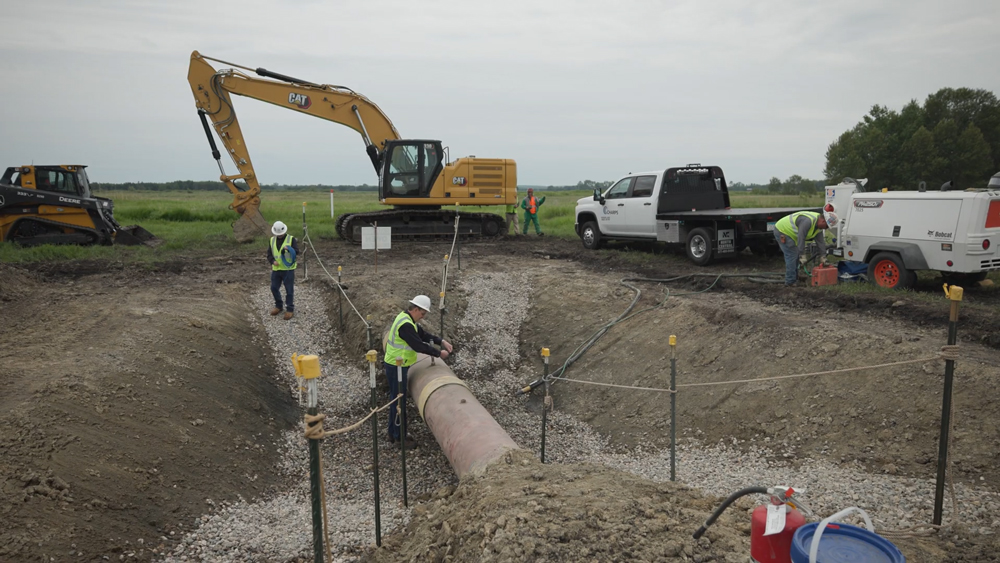
Once the farm taps and couplings were exposed and repaired, the operator re-pressurized the line. With PipeSense continuing to monitor, the pipeline successfully held during the eight-hour hydrotest hold period.
What could have been a prolonged investigation with trial-and-error excavation was resolved quickly thanks to targeted data. As a result, the operator not only passed the hydrotest but also left the project with a more accurate and complete picture of its infrastructure.
Broader Implications for Operators
This case study underscores the broader issue facing many operators: you can’t manage what you don’t know exists. Legacy infrastructure, like farm taps and undocumented fittings, can:
- Cause failed hydrotests, delaying project timelines.
- Create compliance risks if regulators identify missing records.
- Pose safety hazards if left in place, particularly under elevated test pressures.
The Technology Advantage
PipeSense’s approach bridges this gap by:
1 – Mapping the Unknown – Identifying taps and fittings not present in KMZ or GIS files.
2 – Providing Actionable Data – Delivering precise GPS coordinates to guide excavation crews.
3 – Enhancing Compliance – Helping operators align asset records with PHMSA and state regulatory expectations.
PipeSense’s advantage lies in its out-of-band architecture and ability to operate independently of SCADA systems. This makes it particularly effective for hydrotesting, pigging, and isolated test segments, with benefits including:
- High-Frequency Sensing: Captures micro-changes in pressure that traditional systems overlook.
- Advanced Analytics: Proprietary algorithms distinguish between normal stabilization effects and true leak events.
- Field Deployment Capabilities: FPUs can be rapidly deployed in remote environments without permanent infrastructure.
These capabilities not only solve immediate project challenges but also help operators improve long-term asset integrity management.
Conclusion
What once seemed like a small convenience has, decades later, become a serious risk factor for operators striving to meet today’s safety and regulatory standards. PipeSense’s work with the operator and hydrotest company demonstrates how technology can close that gap – turning uncertainty into certainty, hidden risks into known assets, and failed tests into successful outcomes.
For operators across North America, the lesson is clear: unknown farm taps and fittings don’t have to remain hidden. With PipeSense, you can find them, fix them, and move forward with confidence.

What does it take to be PipeSense Certified?
A LOT, and that’s by design. Explore what our quality seal means to us and, more importantly, what it means for you. (Hint: More free time, less frustration.)