

Breaking the Blockage: How PipeScan Helped an Operator Locate Multiple Hydrate Plugs
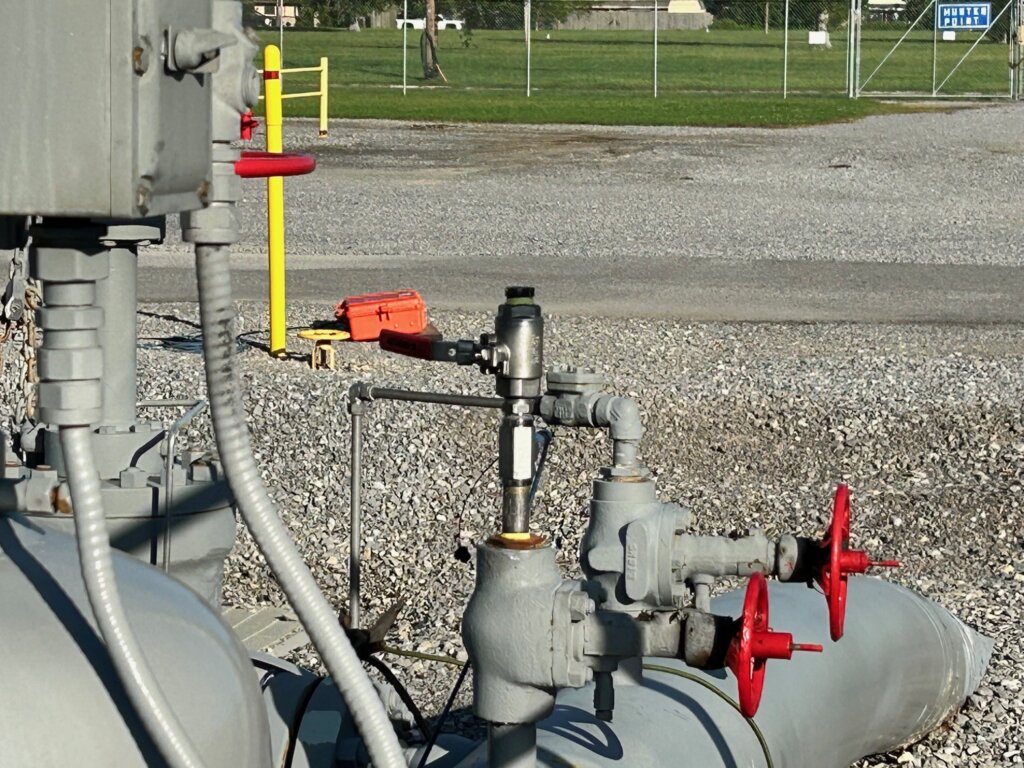
Discover how PipeScan helped an operator transform an ambiguous hydrate event into a solvable engineering challenge.
Background
In the oil and gas industry, flow assurance is a constant battle against physics. One of the most stubborn and problematic adversaries is the hydrate plug—a blockage formed when hydrocarbons under pressure interact with free water in low-temperature conditions. These hydrate crystals resemble ice, but they are stronger, denser, and capable of forming rapidly inside pipelines. Left unchecked, hydrates can accumulate into full-bore plugs that bring operations to a halt.
The presence of a hydrate plug represents more than just lost production. Hydrates are notoriously difficult to predict and virtually impossible to visually confirm without excavation, costly non-destructive examination, or intrusive inspection. Attempts to dislodge or depressurize them can lead to sudden gas releases, with uncontrolled pressure surges risking catastrophic rupture. For operators, this combination of uncertainty, risk, and cost makes hydrate plugs one of the most difficult challenges in flow assurance.
Why Are Hydrate Plugs So Problematic?
Hydrate blockages tend to form when pipelines carrying wet natural gas, NGLs, or crude experience conditions within the hydrate stability region: typically, high pressure and low temperature. Offshore operators often encounter them in subsea lines exposed to frigid seawater, while onshore systems may see hydrates form during winter operations or in long, under-insulated stretches.
The main challenges hydrates bring to operators include:
- Uncertainty of Location: Hydrates do not leave obvious surface clues. A blockage may be suspected miles from its actual location, making excavation or remediation a needle-in-a-haystack exercise.
- High Risk in Removal: Heating, depressurization, or chemical injection strategies can be hazardous. A sudden release of trapped product as a plug breaks free can lead to violent decompression.
- Production Downtime: Even partial restrictions can cut throughput, while full plugs stop operations cold, leading to lost revenue and costly mitigation campaigns.
- Operational Inefficiency: Without precise data, crews may waste days “chasing their tails” along the pipeline, attempting interventions that miss the true blockage point.
For decades, the industry has leaned on a mix of chemical inhibitors (methanol, MEG), insulation, and best-guess remediation to deal with hydrates. But these methods are reactive rather than proactive, and none provide operators with the one thing they need most in a hydrate event: certainty of location.
PipeScan: A New Way to Pinpoint Blockages
PipeSense developed PipeScan to address exactly this problem: accurately locating obstructions inside pipelines, whether hydrate plugs, stuck pigs, or closed valves, without invasive inspection.
The system leverages three key elements:
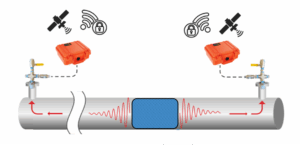
- High-Frequency Pressure Monitoring: PipeScan deploys portable Field Processing Units (FPUs) connected to high-speed pressure sensors on the pipeline. These sensors sample pressure at 1,000 times per second, capturing subtle transients in pipeline behavior.
- Pressure Pulse Induction: By briefly releasing product through a valve and a release manifold, PipeScan generates controlled pressure pulses inside the line. These pulses travel through the pipeline until they encounter a blockage, at which point they reflect back toward the sensors.
- Advanced Signal Analysis: The system accurately timestamps reflections and calculates distances using the speed of sound in the pipeline medium. By cross-referencing readings from multiple FPUs, PipeScan triangulates the exact location of the obstruction, even distinguishing between single plugs and clusters.
Unlike traditional methods, PipeScan works in both static and flowing conditions, requires no pipeline excavation, and is quickly deployed to the field. By combining hardware, analytics, and field expertise, PipeScan transforms what was once guesswork into a precise diagnostic tool.
The Operator Challenge
In March 2025, a U.S. based operator confronted this problem head-on. The operator suspected the presence of a hydrate plug within a 12.5-mile segment of a pipeline line carrying liquid propane, which had gone static under winter conditions, and pressure readings suggested a full blockage.
The operator faced a familiar dilemma: where exactly was the obstruction? Without knowing, crews risked spending days applying heat, depressurization, or inhibitor treatments at the wrong locations. That uncertainty risked prolonged downtime, escalating costs, and increasing safety concerns.
Recognizing the limitations of traditional approaches, the operator contracted PipeSense to deploy PipeScan for rapid hydrate plug location.
Deploying PipeScan in the Field
PipeSense mobilized a team and equipment to the suspected segment. Two Field Processing Units were installed at boundary points of interest, connected to a pressure sensor manifold, powered via portable generators, and linked to PipeSense’s analysis platform through Starlink satellite communications.
The testing procedure involved generating controlled 2–3 second pressure pulses at multiple sites. For each pulse, sensors recorded the reflections returning from the suspected blockage. Tests were repeated three times at five-minute intervals to ensure consistency.
Results: Finding the Needle in the Haystack
The PipeScan campaign quickly narrowed down the hydrate’s location. Across five test series, the system calculated five potential plug points at distances ranging from 2,200 feet to nearly 29,000 feet from test manifolds.
The results revealed two clusters of blockage reflections. This pattern was consistent with hydrate morphology—diffuse, irregular plugs rather than the sharp reflections typical of mechanical obstructions.
Armed with both GPS coordinates and linear distance calculations, the client could confidently target its remediation efforts, reducing wasted time and unnecessary interventions.
As the Director of Operations for the operator summarized: “Without PipeSense’s help, we’d still be chasing our tails on this one.”
Impact: Certainty in the Midst of Uncertainty
By deploying PipeScan, the operator transformed an ambiguous hydrate event into a solvable engineering challenge. The benefits included:
- Rapid Location Intelligence: Instead of days of trial-and-error, the plug’s probable positions were mapped in a single day of testing.
- Reduced Downtime: Clear guidance meant remediation efforts could be focused where they mattered most.
- Improved Safety: By minimizing guesswork, the risk of uncontrolled releases or pipeline damage was reduced.
- Operational Confidence: PipeScan provided not just GPS coordinates but also linear distance references, allowing the operator to validate against its own survey data.
For the operator, this meant faster resolution and a safer return to operations. For PipeSense, it was another demonstration of how modern analytics and field-deployable technology can turn one of the industry’s thorniest problems into a manageable process.

What does it take to be PipeSense Certified?
A LOT, and that’s by design. Explore what our quality seal means to us and, more importantly, what it means for you. (Hint: More free time, less frustration.)