

Meet Dingding Chen: Placing AI-enabled Leak Detection and Pig Tracking on the Map as PipeSense’s Chief Data Scientist

Over 25 years in the oil and gas industry. Responsible for the award of 60+ U.S. patents. The author of more than 30 publications and research papers. Meet Chief Data Scientist, Dingding Chen.
A foundational driver in what separates PipeSense solutions from what is too often standardized in the industry, Dingding has helped utilize the data at our disposal to keep helping us improve and innovate.
Tell us a bit about some of the developments you’ve helped pioneer since joining PipeSense.
I joined PipeSense very early on in the company’s history. After speaking with the team about what they were looking to achieve through this new venture, I jumped at the chance to get involved and felt that my experience could make a pivotal difference.
My main contribution has been to the design and implementation of deep-learning Convolutional Neural Networks (CNN). These networks are a big component of the platforms we provide, thanks to their ability to recognize patterns and provide reliable analysis.
Before PipeSense, leak detection and pig tracking standards had become vastly conventional. The CNNs I have helped design address some of the biggest, longstanding challenges that our customers have faced and that have halted progress. We apply these networks to pipeline pressure measurement classifications for our leak detection and pig-tracking solutions, delivering much more modern and reliable outputs.
Additionally, I am one of the primary developers of the edge and cloud software that forms an integral part of our operations. This means that internally, we live by the same high standards that we promote to our customers. I’m also a Principal Data Analyst for our day-to-day field activities, which allows me access to greater amounts of data that can be utilized for future challenges and customer projects.
Your career covers an impressive mix of relevant topics. Talk us through them and how they have supported your role at PipeSense.
I’ve held roles and gained experience involving several subjects applicable to my position at PipeSense. This has included advisor positions that have focused on artificial intelligence and machine learning, pressure sampling and testing, supporting the design of completion tools, and a background in mechanical engineering. These experiences have equipped me with the relevant tools and problem-solving skills to support my role at PipeSense.
I first achieved a Bachelor’s degree in Mechanical Engineering from the China Agricultural University in Beijing. After moving to the States, I enrolled at Oklahoma State University, where I received a Master’s in Agricultural Engineering, a Master’s in Electrical and Computer Engineering, and a PhD in Electrical and Computer Engineering.
While at OSU, I began working as a Research Assistant, where I developed several network training algorithms and had the opportunity to collaborate on joint research campaigns with companies, including Cummins Inc. and Halliburton. I then joined the Halliburton team on a full-time basis, where I worked for nearly 20 years across several technical and scientific roles. During this time, I worked on developing new methods and processes to optimize pressure sampling and testing, downhole fluid typing, optical sensor adaptive calibration, hydraulic fracturing modeling, and completion tool design.
After moving on from Halliburton, I gained new experiences in synthetic well log generation and software development, and then pipeline leak detection through roles at Quantico Energy Solutions and Proflex Technologies. This mix of career experience has helped me to address pipeline problems and optimize solutions in a multidisciplinary approach.
What is it about PipeSense’s common-sense technology that helps separate it from other solutions out there?
PipeSense’s common-sense technology, which combines cloud integration logic with CNN validation for pig-tracking, for example, is apparent and self-evident to internal and external users.
Our technology leverages but also separates existing solutions like autocorrelation interpretation on multiple sensor data, to provide quick and intuitive judgment on general knowledge about time and frequency data analysis.
What PipeSense technology/solution are you most proud of?
Every solution we provide has been developed to address a skills gap in the market. We are on a mission to revolutionize how companies manage their approach to pipeline monitoring and leak detection.
From my position, because it’s one of my core focus areas, I am immensely proud of how we are supporting digital transformation through our AI-enabled platforms. This has helped to ensure that our customers are no longer just relying on conventional methods and processes, and they have an alternative to chasing false positives or loose ends.
How do you help ensure that PipeSense remains at the forefront of innovation?
It’s vital to know what the latest developments are. Technology is always evolving, and that is especially true of AI. Keeping up to date with the latest breakthroughs and how new processes can be applied to our solutions is crucial. Personally, I do this by engaging in and researching literature reviews and attending technical conferences to learn from peers. My academic background has served me well and made research second nature to me.
Within my role, data is everything, and it assists me in exploring new opportunities for innovation. Modeling, simulation, and other advanced data analysis to support innovation is made a lot more reliable and accessible by building, maintaining, leveraging, and utilizing our measurement database.
When I am looking for new applications, I propose a proof-of-concept and then present the results of a feasibility study for a novel application. This is made possible by our access to real-life practical data and our tenacity for learning.
What is an industry pet peeve of yours?
Within the pipeline industry, there is an overexaggeration of the leak detection limitations of Negative Pressure Wave (NPW) technology for oil and gas pipelines. However, from work demonstrated by PipeSense in the field, we have seen the positive potential of advanced NPW technology and how it can be correctly utilized.

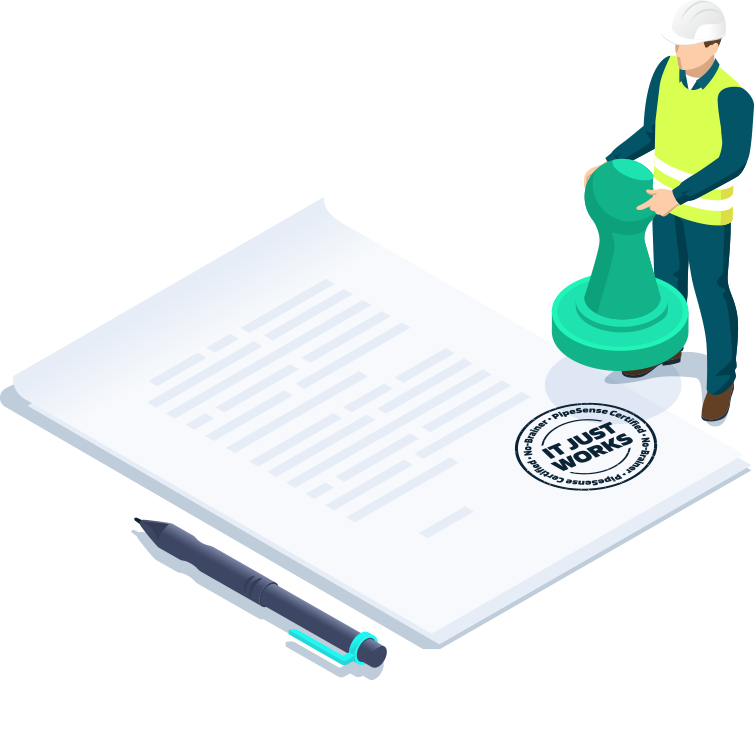
What does it take to be PipeSense Certified?
A LOT, and that’s by design. Explore what our quality seal means to us and, more importantly, what it means for you. (Hint: More free time, less frustration.)