Meet Scott Bauer: Combining Decades of Trusted Expertise with a Future-Ready Outlook as Vice President of Operations

Over his 30-year career, Scott Bauer has held senior management positions in global operations, manufacturing, business development, and customer service. With a strong background in pipeline valve automation and actuators, Scott has witnessed several milestone developments within the pipeline industry over the years, developing a keen eye and insight for how processes can be improved.   

Skilled in building and leading cross-functional teams, in his role as Vice President of Operations at PipeSense, Scott is just as involved in growing our team and helping scale the company up as he is in finding new opportunities and solutions that alleviate the pain and stress that pipeline operators face when it comes to leak detection.   


Tell us a bit about some of the projects and developments you’ve been involved with and supported since joining PipeSense. 

I’ve been part of the team since the formation of PipeSense, before we officially launched to market. In those early days, I helped develop our current FPU hardware and our client-facing dashboards.  

Throughout my career, I’ve often focused on manufacturing, product development, and industrial automation; all three areas were integral to the beginning of PipeSense and how I approached the early stages of getting our hardware and software market-ready.  

Our original offering was predominantly focused on permanent 24/7 monitoring of pipelines for leaks. However, we knew that leak detection was just one area that needed a new approach and that there were several pain points for customers.  

We soon realized that the same technology which powered our leak detection solutions could be applied to additional pipeline operations, such as hydro and pressure testing, pig tracking, identifying blockages, and locating lost or stuck objects. 

Exploring and further developing our involvement within this adjacent space has been very rewarding on a personal level and has helped establish PipeSense as a market leader.  


Your career experience includes a focus on product development and improvement, and industrial automation. How has this mix of career experience supported your role at PipeSense?  

I’m an electrical engineer by schooling (I graduated from Iowa State University with a Bachelor’s in the subject). My education was informative to my early career experiences, where I applied that knowledge across different technical, operational, and management-focused roles within EIM Controls and then Emerson, to support the development and manufacturing of electric valve actuators.  

These early experiences have contributed to my long career in pipeline valve automation, where I have consistently been involved in new product development and expanding existing product lines. Possessing these experiences and my background has been helpful in my role at PipeSense as the team and I create new products and solutions, source the manufacturing of those products, and develop the software and tools that are used by our clients.   

Additionally, I’ve often been involved in the Senior Management units of the businesses in which I’ve worked. Having in-depth management experience has been crucial at PipeSense, too, as we continuously expand our team and scale up the business.  


What PipeSense technology are you most proud of? 

Our PipeGuard solution. The ability to screen out leaks from normal events that happen in pipelines sets us apart, and being able to process in real time, pinpointing a leak event and providing a precise location in five minutes or less, is a game-changer.  

Clients don’t need their hands held when they use our technology.  We provide a solution that just works. Recent developments and implementations revolving around supercritical CO2 will only strengthen our ability to stand out in the market, too.  


How do you keep up to date with the latest challenges that operators are facing? 

Engagement with clients is a significant driver. Every solution we provide has stemmed from early conversations with our clients across the industry. By listening to what they have to say and their biggest pain points, we’ve worked together to create the technology that solves their issues. 

Our solutions are all engineered for each situation, rather than being one-size-fits-all. This provides us with a great deal of flexibility, meaning we can fight back against the most common or recurring pipeline issues, as well as those that may be a nice challenge to a specific client or location. We don’t take a one-size-fits-all approach, and that is reflected in the results we’ve secured to date.  

Outside of client engagement, we are always aiming to be fully aware of our surroundings within the industry, staying up to date with the latest published standards and regulations that impact our clients. These standards help to define the areas that we should explore and consider for future solutions. 


Throughout your career, you have worked with international end users. Following recent agency agreements in Canada and South America, what do PipeSense’s global growth plans look like? 

I’ve been fortunate to have a career that has connected me to many incredible people and leaders all over the world. Much of my career has had a global footprint – both with clients and in-country manufacturing.  

Now, at PipeSense, we are always looking for opportunities to expand our operations to new international markets, depending on the need for our support and where we believe our solutions can make a difference.  

Over the last 18 months, we have been looking for local partners who can support our needs and find value in our technology. While the implementation of our solutions is very easy, we still find it important to have a local presence with clients, hence recent agency agreements. This is a strategy that is likely to persist. Certainly, the Middle East is a vast market with a need for our offering, as is Europe, so I’m excited to exhibit and present a paper at the Pipeline Technology Conference in Berlin later this month. 


What is an industry pet peeve of yours? I.e., a bad practice or a corner cut that has become standardized, negatively impacting the industry’s approach to leak detection. 

Sadly, there are many. However, the one that I’ve heard too many times is how many false alarms that control rooms receive, to the point that the alarms soon become meaningless, and the operator no longer believes their data.  

This is a clear sign that they don’t have a functional leak detection system. This is not good for the operator, those involved in the project, any nearby communities, or the environment. Unfortunately, because their trust in leak detection systems has been eroded, while they realize the need for a well-functioning system, they become wary of anything new as well. This is PipeSense’s mission: to show that there is a better future for pipeline leak detection where common sense prevails.  


New Technology Development to Bring Pig-Tracking into 21st Century

In a bid to revolutionize how operators manage pig tracking within pipelines, the team behind an award-winning portfolio of advanced leak detection and monitoring solutions has introduced a brand-new pigging-oriented technology to the energy market.  

PipeSense, the U.S-based provider of obstruction, leak, and anomaly detection technology, has officially launched its PipeTrack solution.   

Utilizing cutting-edge pressure monitoring and integrating established leak detection software, PipeTrack is a user-friendly and accessible sensor and signal processing system that provides operators with real-time visibility of pipeline pigs. Accessed via a bespoke customer dashboard, PipeTrack stores detailed event data for verification and ongoing analysis should anything unexpected occur during your run.  

Developed in-house by PipeSense expertise, early results from customer trials and installations have yielded accurate and repeatable results in challenging conditions, including reducing downtime and personnel exposure. Backed by AI-enabled data analysis, PipeTrack analyzes the pressure pulses created as the pig moves along the pipeline, determining the pig’s average speed and precise location.   

The introduction of PipeTrack aims to help customers minimize or even move away from traditional methodologies, including Above Ground Markers (AGM), acoustic monitoring, and manual spot checks. While these traditional methods created operational and safety challenges, relating to the uncertainty of specific pig locations when lost or stuck, PipeTrack offers round-the-clock visibility and precise location tracking by maintaining a view of the pig inside the pipeline rather than above it.   

Additionally, PipeTrack handles the entire pig run with a simple installation of sensors utilizing above ground small-bore branch locations, spaced accordingly, mitigating the need to move or repeatedly set up equipment.   

Discussing the development of the software, Stuart Mitchell, President and Chief Technology Officer at PipeSense, commented: “Applying a common-sense approach to pipeline maintenance and integrity is the ethos at PipeSense. Like many other pipeline maintenance processes, pig tracking methodologies have long been outdated and ineffective. Operators have long been overdue a solution that shakes up pig-tracking and meets the modern demands of the industry, and we’re proud to provide it.   

PipeTrack will help empower the industry with a field-proven and reliable solution that transforms time-consuming and resource-heavy manual efforts into an adept platform that offers live feedback.   

For the last two+ years, we have been laser-focused on developing and introducing solutions that can help take midstream operations into the 21st century and beyond. PipeTrack is the latest worthy addition to that aim.” 

Breaking the Blockage: How PipeScan Helped an Operator Locate Multiple Hydrate Plugs

Discover how PipeScan helped an operator transform an ambiguous hydrate event into a solvable engineering challenge. 

Background

In the oil and gas industry, flow assurance is a constant battle against physics. One of the most stubborn and problematic adversaries is the hydrate plug—a blockage formed when hydrocarbons under pressure interact with free water in low-temperature conditions. These hydrate crystals resemble ice, but they are stronger, denser, and capable of forming rapidly inside pipelines. Left unchecked, hydrates can accumulate into full-bore plugs that bring operations to a halt. 

The presence of a hydrate plug represents more than just lost production. Hydrates are notoriously difficult to predict and virtually impossible to visually confirm without excavation, costly non-destructive examination, or intrusive inspection. Attempts to dislodge or depressurize them can lead to sudden gas releases, with uncontrolled pressure surges risking catastrophic rupture. For operators, this combination of uncertainty, risk, and cost makes hydrate plugs one of the most difficult challenges in flow assurance. 


Why Are Hydrate Plugs So Problematic? 

Hydrate blockages tend to form when pipelines carrying wet natural gas, NGLs, or crude experience conditions within the hydrate stability region: typically, high pressure and low temperature. Offshore operators often encounter them in subsea lines exposed to frigid seawater, while onshore systems may see hydrates form during winter operations or in long, under-insulated stretches.  

The main challenges hydrates bring to operators include: 

  • Uncertainty of Location: Hydrates do not leave obvious surface clues. A blockage may be suspected miles from its actual location, making excavation or remediation a needle-in-a-haystack exercise.
  • High Risk in Removal: Heating, depressurization, or chemical injection strategies can be hazardous. A sudden release of trapped product as a plug breaks free can lead to violent decompression.
  • Production Downtime: Even partial restrictions can cut throughput, while full plugs stop operations cold, leading to lost revenue and costly mitigation campaigns. 
  • Operational Inefficiency: Without precise data, crews may waste days “chasing their tails” along the pipeline, attempting interventions that miss the true blockage point.

For decades, the industry has leaned on a mix of chemical inhibitors (methanol, MEG), insulation, and best-guess remediation to deal with hydrates. But these methods are reactive rather than proactive, and none provide operators with the one thing they need most in a hydrate event: certainty of location  


PipeScan: A New Way to Pinpoint Blockages 

PipeSense developed PipeScan to address exactly this problem: accurately locating obstructions inside pipelines, whether hydrate plugs, stuck pigs, or closed valves, without invasive inspection. 

The system leverages three key elements: 

  • High-Frequency Pressure Monitoring: PipeScan deploys portable Field Processing Units (FPUs) connected to high-speed pressure sensors on the pipeline. These sensors sample pressure at 1,000 times per second, capturing subtle transients in pipeline behavior. 
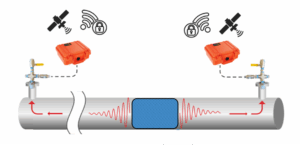
  • Pressure Pulse Induction: By briefly releasing product through a valve and a release manifold, PipeScan generates controlled pressure pulses inside the line. These pulses travel through the pipeline until they encounter a blockage, at which point they reflect back toward the sensors. 
  • Advanced Signal Analysis: The system accurately timestamps reflections and calculates distances using the speed of sound in the pipeline medium. By cross-referencing readings from multiple FPUs, PipeScan triangulates the exact location of the obstruction, even distinguishing between single plugs and clusters.

Unlike traditional methods, PipeScan works in both static and flowing conditions, requires no pipeline excavation, and is quickly deployed to the field. By combining hardware, analytics, and field expertise, PipeScan transforms what was once guesswork into a precise diagnostic tool.  


The Operator Challenge  

In March 2025, a U.S. based operator confronted this problem head-on. The operator suspected the presence of a hydrate plug within a 12.5-mile segment of a pipeline line carrying liquid propane, which had gone static under winter conditions, and pressure readings suggested a full blockage.  

The operator faced a familiar dilemma: where exactly was the obstruction? Without knowing, crews risked spending days applying heat, depressurization, or inhibitor treatments at the wrong locations. That uncertainty risked prolonged downtime, escalating costs, and increasing safety concerns.  

Recognizing the limitations of traditional approaches, the operator contracted PipeSense to deploy PipeScan for rapid hydrate plug location. 


Deploying PipeScan in the Field  

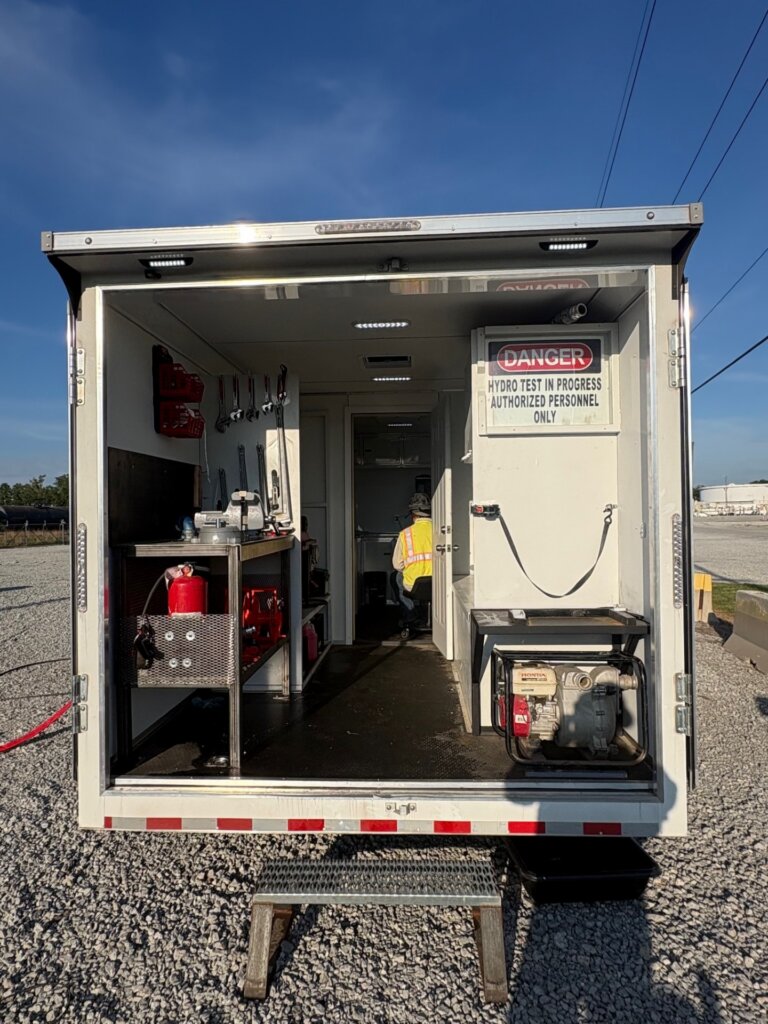
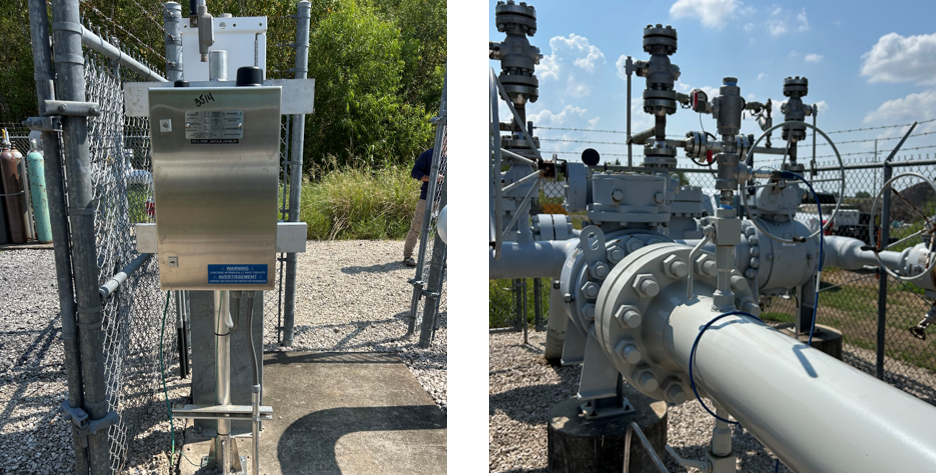
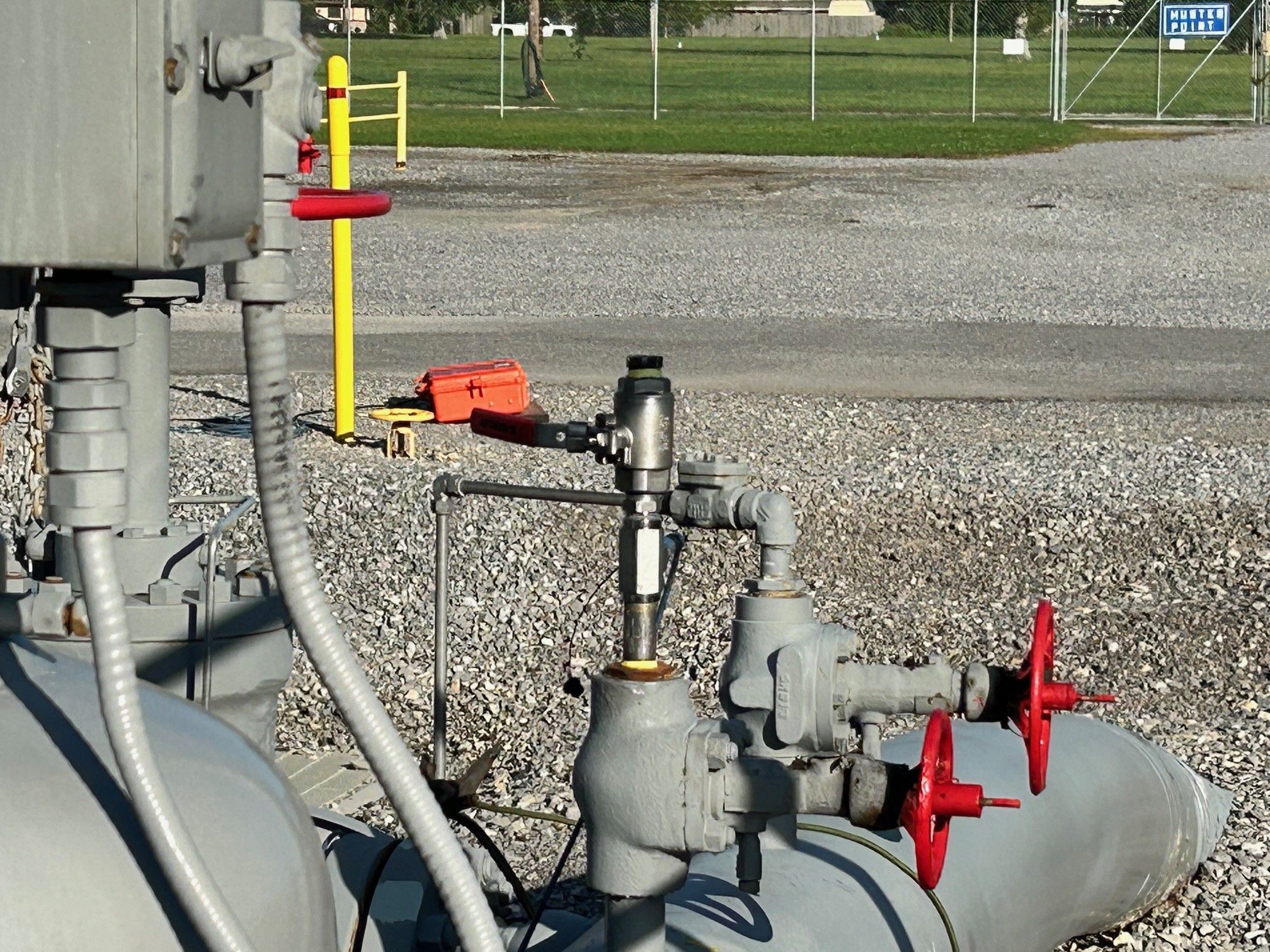
PipeSense mobilized a team and equipment to the suspected segment. Two Field Processing Units were installed at boundary points of interest, connected to a pressure sensor manifold, powered via portable generators, and linked to PipeSense’s analysis platform through Starlink satellite communications.  

The testing procedure involved generating controlled 2–3 second pressure pulses at multiple sites. For each pulse, sensors recorded the reflections returning from the suspected blockage. Tests were repeated three times at five-minute intervals to ensure consistency. 


Results: Finding the Needle in the Haystack  

The PipeScan campaign quickly narrowed down the hydrate’s location. Across five test series, the system calculated five potential plug points at distances ranging from 2,200 feet to nearly 29,000 feet from test manifolds.  

The results revealed two clusters of blockage reflections. This pattern was consistent with hydrate morphology—diffuse, irregular plugs rather than the sharp reflections typical of mechanical obstructions.  

Armed with both GPS coordinates and linear distance calculations, the client could confidently target its remediation efforts, reducing wasted time and unnecessary interventions.  

As the Director of Operations for the operator summarized: “Without PipeSense’s help, we’d still be chasing our tails on this one. 


Impact: Certainty in the Midst of Uncertainty  

By deploying PipeScan, the operator transformed an ambiguous hydrate event into a solvable engineering challenge. The benefits included:  

  • Rapid Location Intelligence: Instead of days of trial-and-error, the plug’s probable positions were mapped in a single day of testing. 
  • Reduced Downtime: Clear guidance meant remediation efforts could be focused where they mattered most. 
  • Improved Safety: By minimizing guesswork, the risk of uncontrolled releases or pipeline damage was reduced.  
  • Operational Confidence: PipeScan provided not just GPS coordinates but also linear distance references, allowing the operator to validate against its own survey data.  

For the operator, this meant faster resolution and a safer return to operations. For PipeSense, it was another demonstration of how modern analytics and field-deployable technology can turn one of the industry’s thorniest problems into a manageable process. 

Hidden Connections, Hidden Risks: Uncovering Unknown Farm Taps in a Texas Pipeline Segment

Explore how PipeTest and PipeScan were deployed to help a major operator uncover previously unknown farm taps and dresser couplings during hydrostatic testing, ensuring the pipeline was brought safely back into service. 


Project Background

In April 2025, PipeSense was contracted by a U.S.-based pipeline operator to monitor the hydrotest of a pipeline segment in Texas. The scope was straightforward: supplement the hydrotest contractor’s efforts with PipeSense’s PipeTest monitoring system, ensuring accurate leak location data was captured during the fill, stabilization, and test-hold phases.  

PipeSense deployed Field Processing Units (FPUs) at strategic points along the line, each outfitted with high-speed pressure sensors capable of capturing pipeline data at 1,000 samples per second. These FPUs, linked to PipeSense’s patented analytics, allowed real-time monitoring of bore pressure fluctuations and precise identification of anomalies. 

Unlike traditional hydrotesting, which may confirm only whether a line holds pressure, PipeTest provides pinpoint leak location, reducing guesswork and excavation. The system can identify new leak events in seconds and locate pre-existing leaks during fill or dewater, often with an accuracy of less than 100 feet. 

Commencing what was expected to be a routine integrity validation, our on-site engineers quickly discovered deeper issues: pressure loss and unexplained leakage, suggesting hidden infrastructure. 


Deployment & Early Signs of Trouble 

As the line was filled and stabilized, anomalies emerged. Pressure drops of approximately 10 psi per hour were recorded, beyond expected temperature-related fluctuations. The PipeTest system flagged multiple points of concern, correlating with potential leak signatures. 

Operators initially suspected small weeps, but PipeSense’s data analysis pointed to something more: previously undocumented farm taps and dresser couplings acting as leak points. 

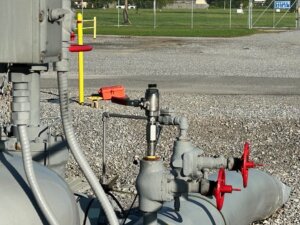
Introduced as a convenience in the mid-20th century, farm taps are direct service lines connected to transmission pipelines, typically feeding individual homes or farms. Never designed to be permanent fixtures in a transmission environment, farm taps now present three categories of challenges today:  

1 – Regulatory Ambiguity – Who owns the tap? Who maintains it? PHMSA has clarified expectations, but many older taps remain in limbo.

2 – Safety Risks – If improperly abandoned, a closed farm tap can still contain pressurized gas or weakened fittings that may leak under stress.

3 – Record Gaps – Many operators rely on outdated KMZ or GIS maps. In cases where taps were installed without formal documentation, records are incomplete or inaccurate.

When an operator believes their line is fully mapped and compliant, discovering hidden farm taps mid-project can derail schedules, add repair costs, and create regulatory exposure. 


Locating the Hidden Taps 

Using a combination of real-time monitoring and offline analysis, PipeSense identified multiple precise GPS coordinates where anomalies suggested hidden connections. Each of these points corresponded to farm taps or dresser couplings that had not been captured in the operator’s KMZ mapping files. 

By locating these features, PipeSense provided actionable intelligence that enabled repairs before the final test-hold was conducted. 


Repair, Retest, and Results 

Once the farm taps and couplings were exposed and repaired, the operator re-pressurized the line. With PipeSense continuing to monitor, the pipeline successfully held during the eight-hour hydrotest hold period. 

What could have been a prolonged investigation with trial-and-error excavation was resolved quickly thanks to targeted data. As a result, the operator not only passed the hydrotest but also left the project with a more accurate and complete picture of its infrastructure. 


Broader Implications for Operators 

This case study underscores the broader issue facing many operators: you can’t manage what you don’t know exists. Legacy infrastructure, like farm taps and undocumented fittings, can: 

  • Cause failed hydrotests, delaying project timelines. 
  • Create compliance risks if regulators identify missing records. 
  • Pose safety hazards if left in place, particularly under elevated test pressures. 


The Technology Advantage 

PipeSense’s approach bridges this gap by: 

1 – Mapping the Unknown – Identifying taps and fittings not present in KMZ or GIS files.

2 – Providing Actionable Data – Delivering precise GPS coordinates to guide excavation crews.

3 – Enhancing Compliance – Helping operators align asset records with PHMSA and state regulatory expectations. 

PipeSense’s advantage lies in its out-of-band architecture and ability to operate independently of SCADA systems. This makes it particularly effective for hydrotesting, pigging, and isolated test segments, with benefits including: 

  • High-Frequency Sensing: Captures micro-changes in pressure that traditional systems overlook. 
  • Advanced Analytics: Proprietary algorithms distinguish between normal stabilization effects and true leak events. 
  • Field Deployment Capabilities: FPUs can be rapidly deployed in remote environments without permanent infrastructure. 

These capabilities not only solve immediate project challenges but also help operators improve long-term asset integrity management. 


Conclusion 

What once seemed like a small convenience has, decades later, become a serious risk factor for operators striving to meet today’s safety and regulatory standards. PipeSense’s work with the operator and hydrotest company demonstrates how technology can close that gap – turning uncertainty into certainty, hidden risks into known assets, and failed tests into successful outcomes.  

For operators across North America, the lesson is clear: unknown farm taps and fittings don’t have to remain hidden. With PipeSense, you can find them, fix them, and move forward with confidence. 

Meet Dingding Chen: Placing AI-enabled Leak Detection and Pig Tracking on the Map as PipeSense’s Chief Data Scientist

Over 25 years in the oil and gas industry. Responsible for the award of 60+ U.S. patents. The author of more than 30 publications and research papers. Meet Chief Data Scientist, Dingding Chen. 

A foundational driver in what separates PipeSense solutions from what is too often standardized in the industry, Dingding has helped utilize the data at our disposal to keep helping us improve and innovate.  


Tell us a bit about some of the developments you’ve helped pioneer since joining PipeSense. 

I joined PipeSense very early on in the company’s history. After speaking with the team about what they were looking to achieve through this new venture, I jumped at the chance to get involved and felt that my experience could make a pivotal difference. 

My main contribution has been to the design and implementation of deep-learning Convolutional Neural Networks (CNN). These networks are a big component of the platforms we provide, thanks to their ability to recognize patterns and provide reliable analysis. 

Before PipeSense, leak detection and pig tracking standards had become vastly conventional. The CNNs I have helped design address some of the biggest, longstanding challenges that our customers have faced and that have halted progress. We apply these networks to pipeline pressure measurement classifications for our leak detection and pig-tracking solutions, delivering much more modern and reliable outputs. 

Additionally, I am one of the primary developers of the edge and cloud software that forms an integral part of our operations. This means that internally, we live by the same high standards that we promote to our customers. I’m also a Principal Data Analyst for our day-to-day field activities, which allows me access to greater amounts of data that can be utilized for future challenges and customer projects. 


Your career covers an impressive mix of relevant topics. Talk us through them and how they have supported your role at PipeSense. 

I’ve held roles and gained experience involving several subjects applicable to my position at PipeSense. This has included advisor positions that have focused on artificial intelligence and machine learning, pressure sampling and testing, supporting the design of completion tools, and a background in mechanical engineering. These experiences have equipped me with the relevant tools and problem-solving skills to support my role at PipeSense. 

I first achieved a Bachelor’s degree in Mechanical Engineering from the China Agricultural University in Beijing. After moving to the States, I enrolled at Oklahoma State University, where I received a Master’s in Agricultural Engineering, a Master’s in Electrical and Computer Engineering, and a PhD in Electrical and Computer Engineering.  

While at OSU, I began working as a Research Assistant, where I developed several network training algorithms and had the opportunity to collaborate on joint research campaigns with companies, including Cummins Inc. and Halliburton. I then joined the Halliburton team on a full-time basis, where I worked for nearly 20 years across several technical and scientific roles. During this time, I worked on developing new methods and processes to optimize pressure sampling and testing, downhole fluid typing, optical sensor adaptive calibration, hydraulic fracturing modeling, and completion tool design. 

After moving on from Halliburton, I gained new experiences in synthetic well log generation and software development, and then pipeline leak detection through roles at Quantico Energy Solutions and Proflex Technologies. This mix of career experience has helped me to address pipeline problems and optimize solutions in a multidisciplinary approach.      


What is it about PipeSense’s common-sense technology that helps separate it from other solutions out there? 

PipeSense’s common-sense technology, which combines cloud integration logic with CNN validation for pig-tracking, for example, is apparent and self-evident to internal and external users. 

Our technology leverages but also separates existing solutions like autocorrelation interpretation on multiple sensor data, to provide quick and intuitive judgment on general knowledge about time and frequency data analysis. 


What PipeSense technology/solution are you most proud of? 

Every solution we provide has been developed to address a skills gap in the market. We are on a mission to revolutionize how companies manage their approach to pipeline monitoring and leak detection. 

From my position, because it’s one of my core focus areas, I am immensely proud of how we are supporting digital transformation through our AI-enabled platforms. This has helped to ensure that our customers are no longer just relying on conventional methods and processes, and they have an alternative to chasing false positives or loose ends.  


How do you help ensure that PipeSense remains at the forefront of innovation? 

It’s vital to know what the latest developments are. Technology is always evolving, and that is especially true of AI. Keeping up to date with the latest breakthroughs and how new processes can be applied to our solutions is crucial. Personally, I do this by engaging in and researching literature reviews and attending technical conferences to learn from peers. My academic background has served me well and made research second nature to me. 

Within my role, data is everything, and it assists me in exploring new opportunities for innovation. Modeling, simulation, and other advanced data analysis to support innovation is made a lot more reliable and accessible by building, maintaining, leveraging, and utilizing our measurement database. 

When I am looking for new applications, I propose a proof-of-concept and then present the results of a feasibility study for a novel application. This is made possible by our access to real-life practical data and our tenacity for learning. 


What is an industry pet peeve of yours? 

Within the pipeline industry, there is an overexaggeration of the leak detection limitations of Negative Pressure Wave (NPW) technology for oil and gas pipelines. However, from work demonstrated by PipeSense in the field, we have seen the positive potential of advanced NPW technology and how it can be correctly utilized.